The post-silicon yield bottleneck, and what to do about it
Thousands of STDF files, pressure from the fab, and a yield curve that will not climb. Generic tools and public AI models are the wrong answer, for reasons that matter.
In the race to market, every percentage point of yield is a competitive edge. Yet in next-generation architectures, the post-silicon phase has become the production bottleneck.
You are drowning in data: thousands of STDF files, mounting pressure from the fab, and a yield curve that refuses to climb. Most teams are still fighting this battle with manual correlation, generic scripts, and spreadsheets. Relying on public AI models for technical analysis adds another problem, since it introduces real risks of IP leakage and legal exposure.
Your data is too complex and too sensitive for generic tools.
VISTAR: an AI engine built for silicon
Generic AI fails without domain context. It cannot tell a test bin from a yield bin, and it does not grasp ATE nuances. VISTAR is built for silicon: a secure, modular AI engine designed for the semiconductor lifecycle.
- Secure. Runs fully on-premises, so design data never leaves your network and IP leakage risk is removed.
- Domain-specific. Modules such as SightFiX for hardware failure pattern detection speak the language of silicon.
- Practical. Users report meaningful productivity gains in documentation, test debugging, and analysis.
The end of manual test limits
If you are still setting test limits by hand, you are leaving functional die on the table.
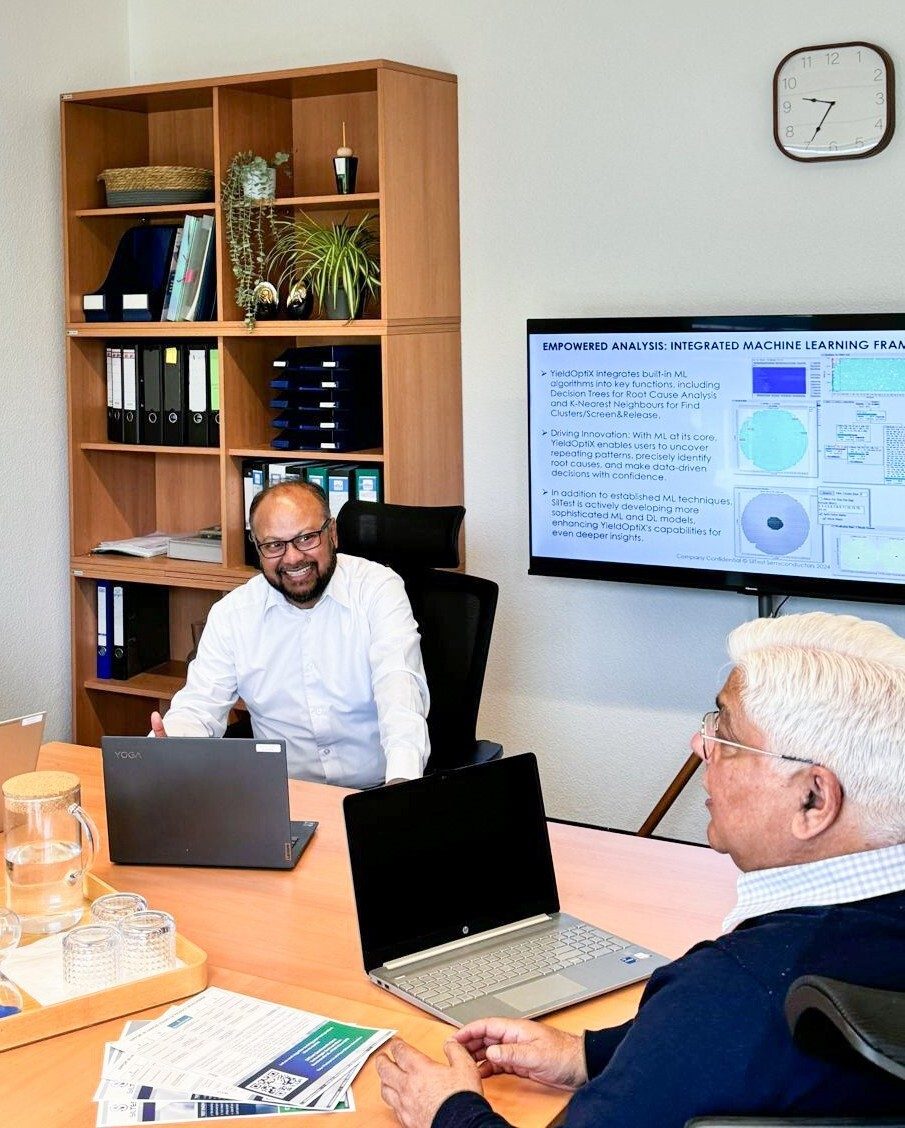
Our update to YieldOptiX introduces adaptive limits rounding, a machine learning feature that analyzes real distribution data to optimize test limits, moving beyond static, conservative boundaries.
| Metric | Traditional analysis | YieldOptiX |
|---|---|---|
| Data source | Manual CSV and Excel | Automated, secure STDF pipeline |
| Root cause | Hours of manual correlation | ML-driven clustering |
| Limit setting | Static, conservative limits | Adaptive limits rounding |
That is the difference between analyzing data and acting on it.
Where to start
The future of semiconductor engineering is not about generating more data. It is about turning the data you already have into decisions you can defend.